
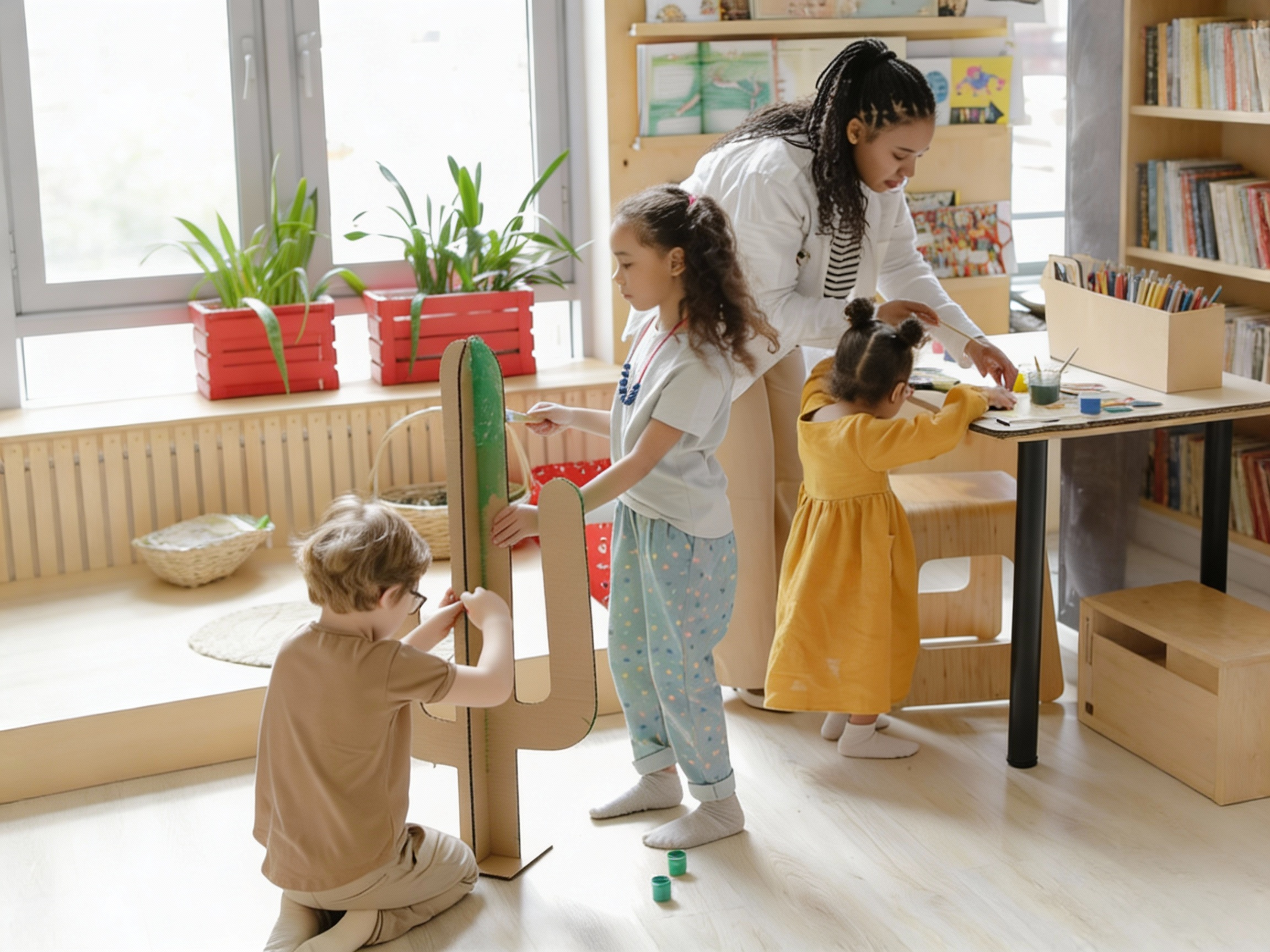
Childhood engagement is not just about keeping kids “busy.” Engagement is the fuel for learning: it shapes how children build language, social connection, self-regulation, and the executive function skills that support focus, working memory, and flexible thinking. In early childhood development research, one theme is consistent: children learn best through responsive relationships, safe environments, and experiences that strengthen skills over time through practice—not passive exposure.
What is changing is the environment children are developing within. Many children are navigating higher stimulation, faster feedback loops, more variable attention demands, and shifting family routines. Engagement methods are adapting accordingly—without changing the fundamentals of how development works.
A growing share of engagement strategy starts with regulation. If a child is dysregulated—overwhelmed, anxious, overstimulated, or shut down—engagement tools that rely on compliance or willpower tend to fail. In practice, “engagement” increasingly means helping children reach a calm-alert state through co-regulation, then building participation from there.
A common method is “serve and return” interaction: an adult notices the child’s cue (a look, gesture, question, sound) and responds in a way that keeps the exchange going. This creates connection, which improves readiness to engage. Programs also lean on emotion labeling and bounded choices (“You seem frustrated—do you want to try again or take a break?”) because it reduces conflict while preserving autonomy. Predictable micro-routines help too: short opening and closing rituals (songs, call-and-response, previews of what happens next) lower uncertainty and make it easier for children to sustain focus.
Play-based learning is being positioned more explicitly as a high-yield engagement tool. The most common shift is toward guided play: children have meaningful choice, but adults design the environment and prompts so learning goals are embedded in the activity. This keeps the experience intrinsically motivating while still building specific skills.
In classrooms, this shows up as choice-rich learning centers with simple prompts that clarify what children can do and what success looks like. It also shows up as narrative problem solving—missions like “build a bridge for the animal” or “open a bakery”—because story makes effort feel purposeful. Many educators also move from concrete to abstract on purpose: manipulatives and hands-on construction first, then symbols and worksheets later, because children stay engaged longer when they can physically test ideas.
Adults are increasingly designing engagement in short cycles rather than long stretches of instruction. This reflects what many children experience outside school: short-form, rapid-feedback digital content and games that reward quick iteration. The objective is not to imitate screens, but to recognize that attention is trained by context.
In practice, lessons are broken into short loops: a brief input, a quick “do,” then a share-out or reflection. Children get faster, more specific feedback, which supports persistence. Progress is also made more visible through simple trackers and skill ladders—not to gamify everything, but to help children see that effort is producing movement. The key is balancing novelty with calm. Too much stimulation becomes counterproductive, so many environments intentionally rotate between active and quiet modes.
Executive function skills—working memory, inhibitory control, cognitive flexibility—are increasingly treated as foundational to engagement. When these skills are stronger, children can stay with tasks longer, recover from frustration more quickly, and shift between instructions without melting down.
That is why many settings build these skills through routine, not lectures. Rule-switching games, multi-step directions supported by visuals, and planning language (“What’s your first step?” “What will you do if that doesn’t work?”) are common. These techniques increase engagement because they reduce the cognitive load of figuring out what is expected and strengthen the child’s ability to keep going.
Engagement approaches are increasingly designed for variability: different temperaments, language backgrounds, attention profiles, and sensory needs. The method is not to lower expectations, but to widen how participation can look so more children can access the same learning goal.
This often means building multi-modal entry points into activities. A child might respond by speaking, drawing, building, moving, pointing, or acting something out. Nonverbal response tools (picture cards, gestures, demonstrations) help children participate before language is fully ready or when anxiety is high. Many classrooms also adopt sensory-aware design—quiet corners, planned movement breaks, and other supports used proactively to prevent disengagement rather than reacting after behavior escalates.
The trend is less about whether screens exist and more about what children are doing with them and whether an adult is helping connect the experience to real life. Passive consumption tends to produce shorter attention and weaker transfer. Co-use and active creation are increasingly preferred.
Co-use looks like watching or playing together and pausing to ask questions, name emotions, or connect what happened on the screen to the child’s life. Active creation looks like turning digital input into output: making a short story, recording an explanation, building something off-screen, or using a tool to practice a specific skill. Many caregivers also “right-channel” technology by using it for particular purposes—communication, creativity, practice—rather than as the default solution for boredom or distress.
Programs are increasingly treating caregivers as part of the learning environment, not a separate audience. This is because engagement is easier to sustain when routines and expectations are consistent across settings.
The most common modern approach is making it easy to implement, not idealized. Instead of sending long packets, educators provide one short carryover activity a family can repeat in two minutes. Many also encourage families to build language and narrative skills in the language they use most at home, because connection and consistency matter more than perfect alignment with school vocabulary. The tone is increasingly strength-based—“here’s what your child did well and how to build on it”—because families are more likely to follow through when they feel respected and capable.
Early childhood classrooms (roughly ages 0–5)
Engagement improves when the day is built around interaction loops, not long teacher talk. Stations and choice work best when boundaries are simple and success is visible. Rotating between movement, story, and hands-on tasks keeps attention aligned with developmental limits.
Elementary settings (roughly ages 6–11)
Short cycles tend to outperform long lessons: teach, do, show, refine. Peer collaboration is often more effective when roles are structured so participation is predictable. Goals should be narrow enough to feel winnable (“Today we practice one thing: evidence”) so effort stays high.
Home routines (caregiving)
At home, regulation and connection drive engagement more than rules do. Clear “what to do next” prompts outperform repeated “stop” commands. Predictable rituals and small responsibilities (“help me set this up”) create ownership, which tends to keep children engaged longer.
The strongest overall trend is that engagement is increasingly treated as a designed experience built through responsive relationships, predictable structure, autonomy, and developmentally matched challenge. When those conditions are in place, attention becomes less of a daily fight and more of a natural outcome of safety, meaning, and momentum.

ChangEdwardS partners with creative leaders in business and society to tackle complex and important challenges. Our focus is on business strategy that brings transformational approaches. We want to empower organizations to grow and build sustainable competitive advantages that bring a positive impact to society. We bring deep industry specific functional expertise with a range of perspectives that question the status quo.
© ChangEdwardS. All rights reserved